
How data-driven pricing increases your revenue — and why SereneHost recommends and applies it to every managed property.
For STR owners, dynamic pricing replaces a fixed nightly rate with prices that adapt daily — rising when demand is strong, easing when occupancy lags. The goal is to capture every dollar of revenue opportunity while avoiding the vacancy penalty of overpricing.
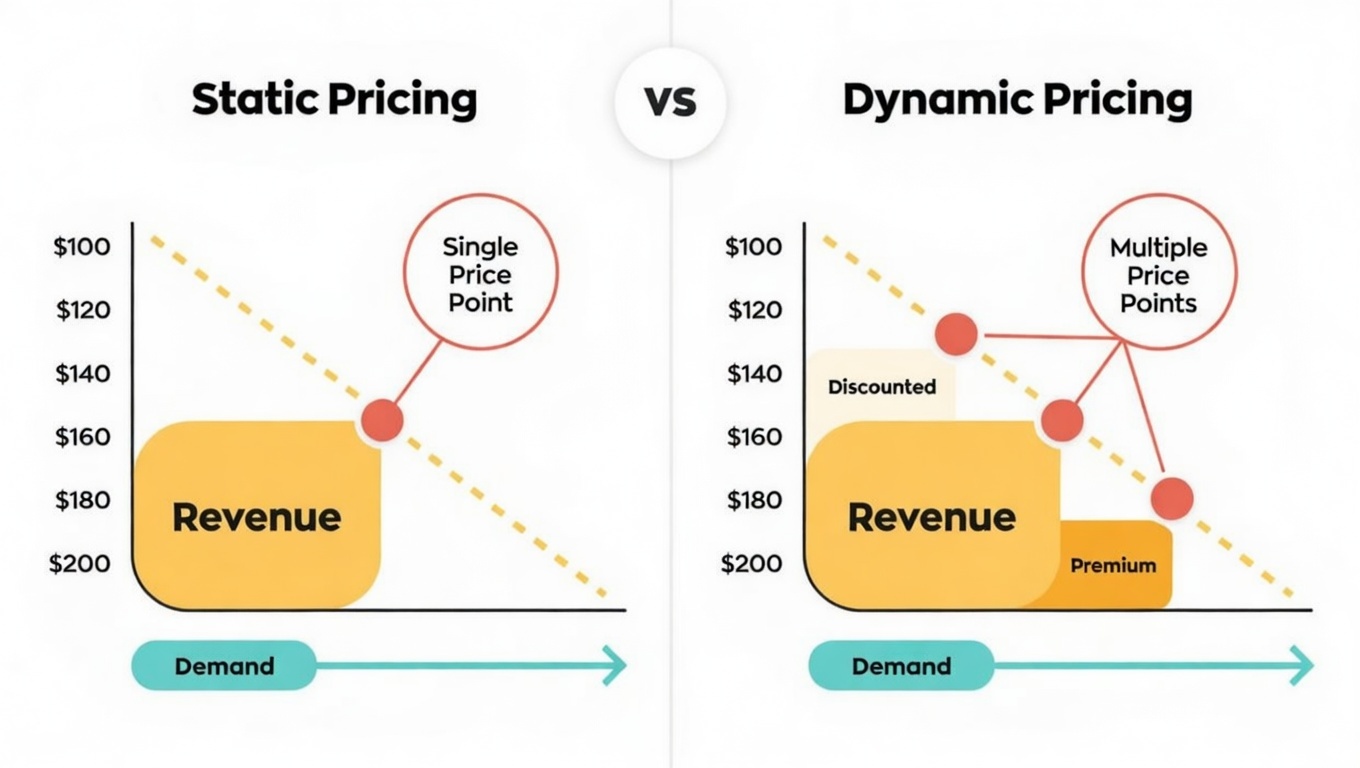
One fixed rate set manually — rarely updated, never optimized for current conditions.
Rates adjusted algorithmically every day based on demand signals, competitor data, and booking pace.
Dynamic pricing is grounded in three economic principles that explain why adjusting rates over time produces more revenue than a fixed price.

A vacant night cannot be recovered. If March 10 goes unbooked, its revenue is permanently zero. Pricing must adapt as check-in approaches to avoid total revenue loss — even last-minute discounting can increase total revenue when the alternative is zero.

Demand responds differently at different prices. During a Taylor Swift concert at BC Place: demand is inelastic — guests tolerate higher prices. In rainy November midweek: demand is elastic — a small price increase kills bookings. Dynamic models estimate this elasticity and set the rate that maximizes expected revenue.

Borrowed from airlines and hotels: the goal is not the highest price — it is maximum RevPAR. In Vancouver, this means premium pricing in July–August, controlled discounting in January–February, and strategic rate shifts before major conventions.
These five metrics form the core of any revenue management framework. Understanding them is the first step to evaluating whether your pricing is working.
| Metric | Definition | Why It Matters |
|---|---|---|
| ADR | Average Daily Rate — total room revenue divided by nights booked | Measures price performance; high ADR alone is not enough if occupancy suffers |
| Occupancy Rate | Percentage of available nights that were booked | Measures demand capture; high occupancy at low ADR is also suboptimal |
| RevPAR | Revenue per Available Night — ADR multiplied by Occupancy Rate | Core efficiency metric; optimising RevPAR balances both price and occupancy simultaneously |
| Booking Lead Time | Days between when a booking is made and the check-in date | Informs when to raise or lower rates — fast pace signals strong demand; slow pace signals price resistance |
| Price Elasticity | Sensitivity of booking probability to price changes at a given point in time | Key input for algorithmic optimisation — determines how aggressively to discount or surcharge |
Dynamic pricing maximises RevPAR, not just ADR.
Applied correctly, dynamic pricing delivers measurable improvements across five dimensions of STR performance.
Industry data shows 10–40% revenue increase versus static pricing. Dynamic pricing captures surge demand, event-driven spikes, and holiday multipliers that a fixed rate will systematically miss.
Balances ADR against occupancy — avoiding the common trap of chasing a high nightly rate while accumulating vacancies. The objective is always to maximize RevPAR, not just price.
Prices rise automatically when bookings come in fast, protecting future high-yield nights. Rates ease when pace slows, filling the calendar before vacancy risk becomes permanent.
In dense markets like Downtown Vancouver, even small pricing differences affect Airbnb search ranking and click-through rate. Algorithmic pricing keeps your listing competitive without daily manual updates.
Reduces long vacancy gaps, off-season overpricing, and missed demand surges from unexpected events. Systematic pricing removes the biggest sources of unforced revenue loss.
Vancouver's specific conditions determine where dynamic pricing creates the most value. Not every scenario benefits equally — here is a market-by-market assessment.

Vancouver exhibits strong intra-year demand variance: peak July–August (tourism, cruise season, festivals), shoulder May–June and September, and a clear trough November–February. Static pricing creates two simultaneous inefficiencies — underpricing summer peaks and overpricing winter troughs. Dynamic pricing captures cruise passenger surges, BC Place event spikes, long weekend spillovers, and cherry blossom tourism.

In Yaletown, Coal Harbour, and Olympic Village, listings compete within narrow geographic radii where guests comparison-shop aggressively. On platforms like Airbnb, small pricing differences affect search ranking, click-through rate, and conversion probability. Algorithmic pricing improves competitive positioning when inventory is homogeneous and margins are tight.

Vancouver demand is event-sensitive: major concerts at BC Place, large conventions, marathon weekend, fireworks festival, and international conferences all create temporary demand spikes. Dynamic systems that track booking pace capture these surges more reliably than manual monitoring. Note: manual override may still be required for rare mega-events.

If the owner cannot monitor pricing daily, does not track comparable listings regularly, or is not analyzing booking pace, dynamic pricing provides automation that meaningfully reduces mispricing risk. In Vancouver's fast-moving summer market, weekly manual updates are often insufficient to stay competitive.

Vancouver requires STRs to be the host's principal residence, limiting availability, requiring personal-use date blocks, and preventing multi-unit scaling. This reduces portfolio optimization benefits and multi-unit yield management gains. Dynamic pricing remains useful for individual units, but its impact is smaller than in investor-owned multi-property markets.

Weak discretionary travel demand, weather-driven cancellations, and reduced U.S. tourism characterize November–February. Aggressive dynamic discounting may increase occupancy while reducing net profitability and attracting low-margin stays. A strong floor rate strategy matters more than algorithmic precision — dynamic pricing is valuable only when floor rates account for cleaning and turnover costs.

For high-end Coal Harbour or Kitsilano properties, brand perception and rate integrity signal quality. Excessive volatility may undermine positioning and signal desperation. Luxury listings benefit from demand-based surcharges and controlled discount bands — not aggressive algorithmic swings that erode the perceived exclusivity of the listing.
Dynamic pricing is not automatically optimal. Without professional oversight, common configuration errors can reduce net revenue below what static pricing would have achieved.
Dynamic pricing is not a plug-and-play tool. Its value depends entirely on how it is configured and monitored.
Dynamic pricing is fundamentally a probabilistic revenue optimization framework applied to perishable real estate inventory. For STR owners, it simultaneously increases revenue, reduces vacancy risk, enhances competitive positioning, and automates market responsiveness — but only when implemented with professional discipline.
What It Delivers
What It Requires
SereneHost’s pricing system combines two complementary analytical approaches to produce recommendations that are both accurate and adaptive.
Gradient boosting regression models estimate the relationship between price and booking probability across multiple variables — room type, location, amenities, reviews, peer pricing, and seasonality. In tested short-term rental markets, these models achieve R² ≈ 0.63 and mean absolute error around $33 per night, providing a quantitative baseline for each pricing decision.
Bayesian networks classify listings as underpriced, competitively priced, or overpriced relative to peers — generating interpretable probability estimates that guide rate decisions. For platform-level forecasting, Bayesian structural time series (BSTS) and Bayesian Dirichlet ARMA (BDARMA) models update demand predictions under regime changes — including policy interventions and demand shocks — keeping pricing strategies robust when market conditions shift. Research also shows that hosts initially underestimate algorithmic gains by 5–6.6%, but update their beliefs as they observe realized prices, accelerating adoption and strategy refinement over time.
Empirical industry data shows dynamic pricing delivers 10–40% revenue increases over static pricing, varying by market maturity and host sophistication. Bayesian updating adds a further 1.7–11.9% on top — compounding returns through adaptive, data-driven refinement.
⚠ Note: Revenue estimates and pricing outcomes vary by property, location, and market conditions. The figures cited (10–40% revenue uplift) are industry benchmarks and are not guaranteed results. Dynamic pricing performance depends on market conditions, property characteristics, and management quality. Last updated: March 2026.